





Bridges
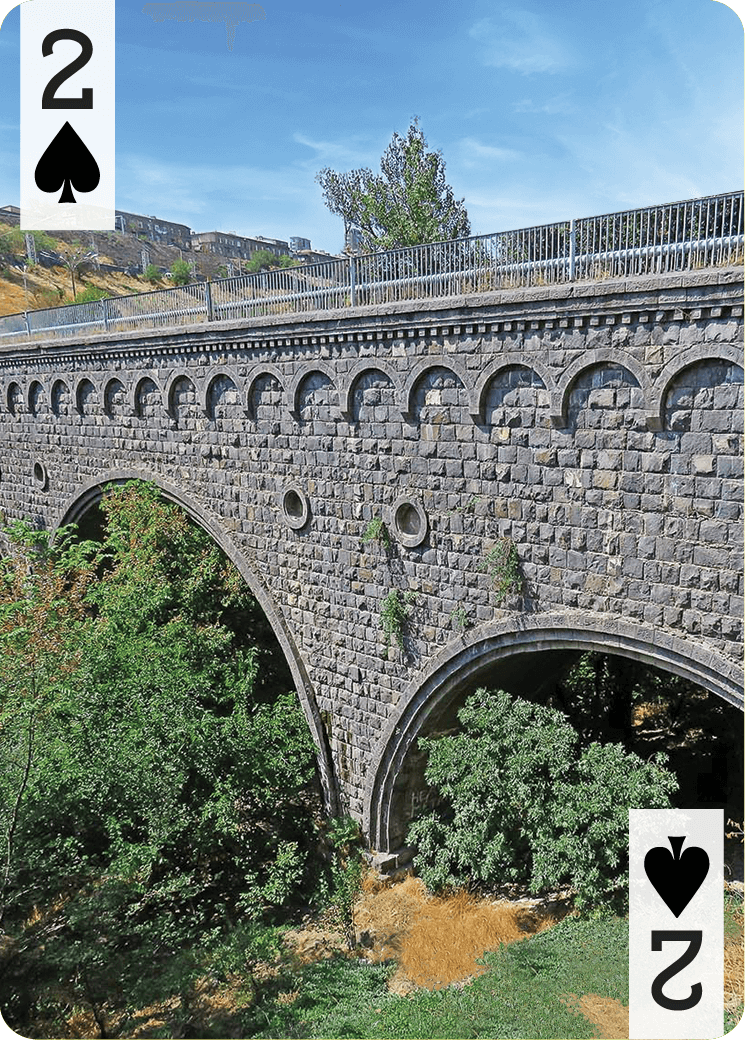
2 of Spades – Yerevan Red Bridge
The Yerevan Red Bridge was built in the 12th century. It served as the main entry point for all caravans coming into the city and also connected the Erivan Fortress with the Ararat Valley. Built from reddish bricks, it came to be known as the Red Bridge. However, the structure is also associated with a wealthy resident of Kanaker, Khoja Plav, who financed the bridge’s restoration after the 1679 earthquake.
Until the mid-1940s—before the construction of the Victory Bridge—the Red Bridge remained the main and only bridge over the Hrazdan River connecting the city with the right bank.
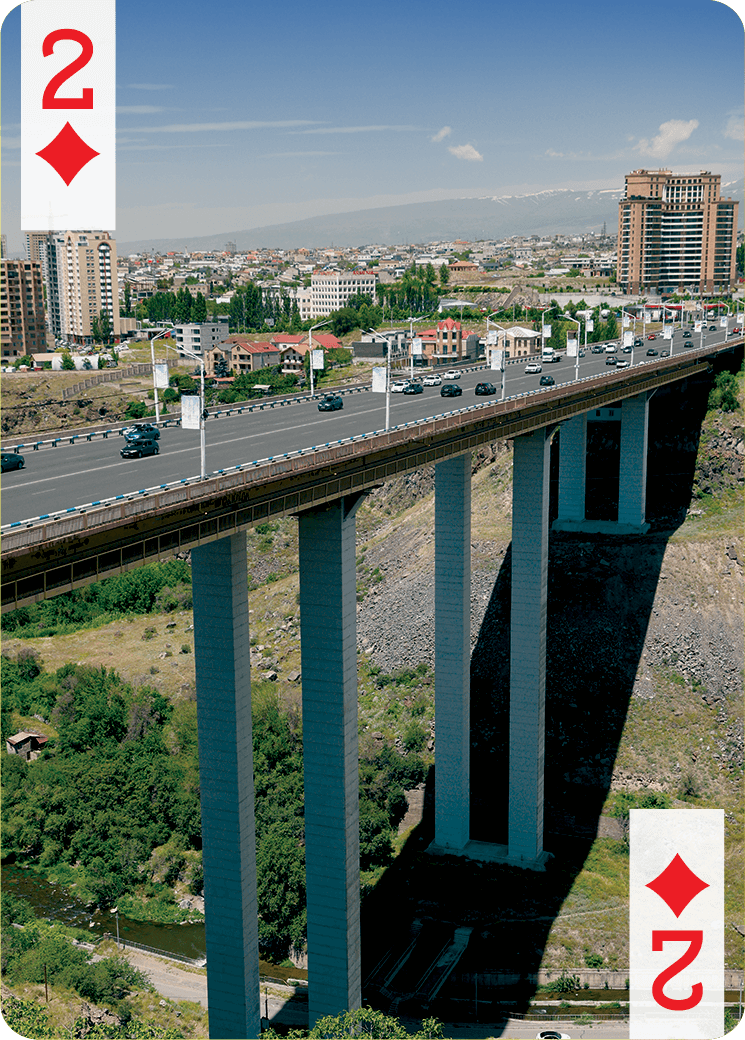
2 of Diamonds – Davtashen Bridge
Construction of the bridge, aimed at connecting the Davtashen district—cut off by the Hrazdan Gorge—with the city, began in 1978. Before that, the nearest route to Davtashen was via the Kievyan Bridge, built in 1956.
Soon after construction began, work was suspended and resumed only after the collapse of the Soviet Union. The bridge was put into operation in 2000. At the entrance from the Davtashen side, a memorial plaque honors Semyon Armenovich Baghdasaryan, the project’s author and chief architect.
Due to its height and convenient location, the Davtashen Bridge is used by thrill-seekers for bungee jumping and ziplining.
The total length of the bridge is 496 meters and its width is 32 meters.
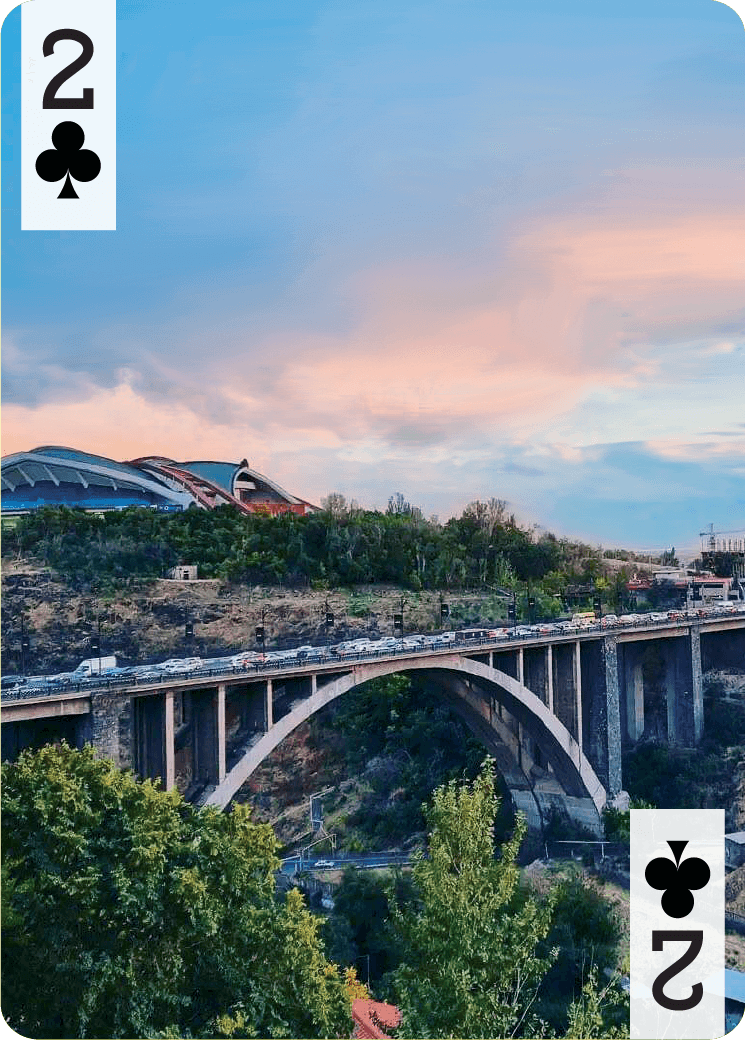
2 of Clubs – Great Hrazdan Bridge
The ceremonial opening of the Great Hrazdan Bridge, better known as the Kievyan Bridge, took place on May 12, 1956. At the time, suspended more than 60 meters above the gorge and stretching 335 meters in length, it was one of the largest bridges in Europe.
The bridge entered service “on the second attempt” — the first structure collapsed, leading to the deaths of several dozen people, mostly prisoners of war. There are several versions of the tragedy; the most credible being that the metal frameworks of the half-arches, once joined, were fastened with bolts made of a substandard steel grade that couldn’t bear the load.
The second strength test was passed with flying colors: the bridge was loaded with heavy stone-laden trucks, engineers measured the deflection under the load, and spectators gathered on Tsitsernakaberd Hill and on the side where Yerevan’s Cheryomushki neighborhood would soon appear, watched and prayed that the disaster wouldn’t repeat. Fortunately, all went well, and architect Grigor Aghababyan’s creation became one of Yerevan’s landmarks.
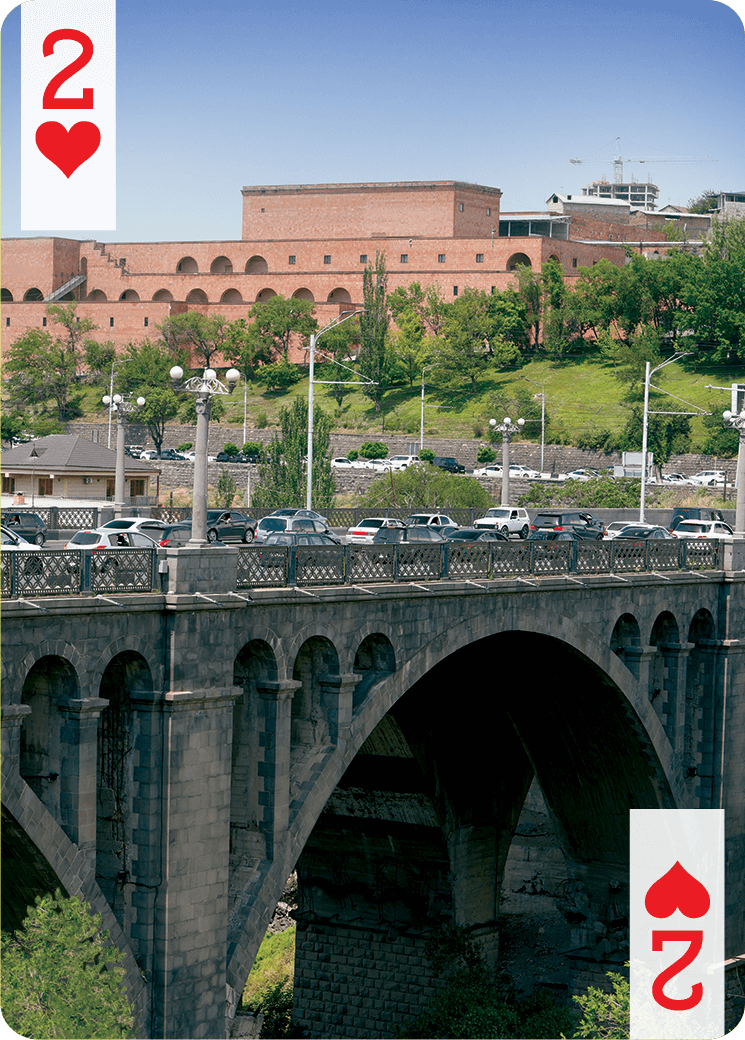
2 of Hearts – Victory Bridge
Construction of the bridge began in 1941, and on November 25, 1945, it was completed and inaugurated as the Victory Bridge, commemorating the defeat of Nazi Germany in World War II.
It is a seven-arch bridge over the Hrazdan River in Yerevan. The bridge is 200 meters long, 25 meters wide, and 34 meters high.
Due to the shortage of labor during the war, after the Battle of Stalingrad, the first groups of German prisoners of war joined the bridge’s construction.
It became the largest wartime engineering project in Armenia.
The project was designed by engineer S. Hovnanyan and architects A. Mamijanyan and A. Asatryan.