


Churches
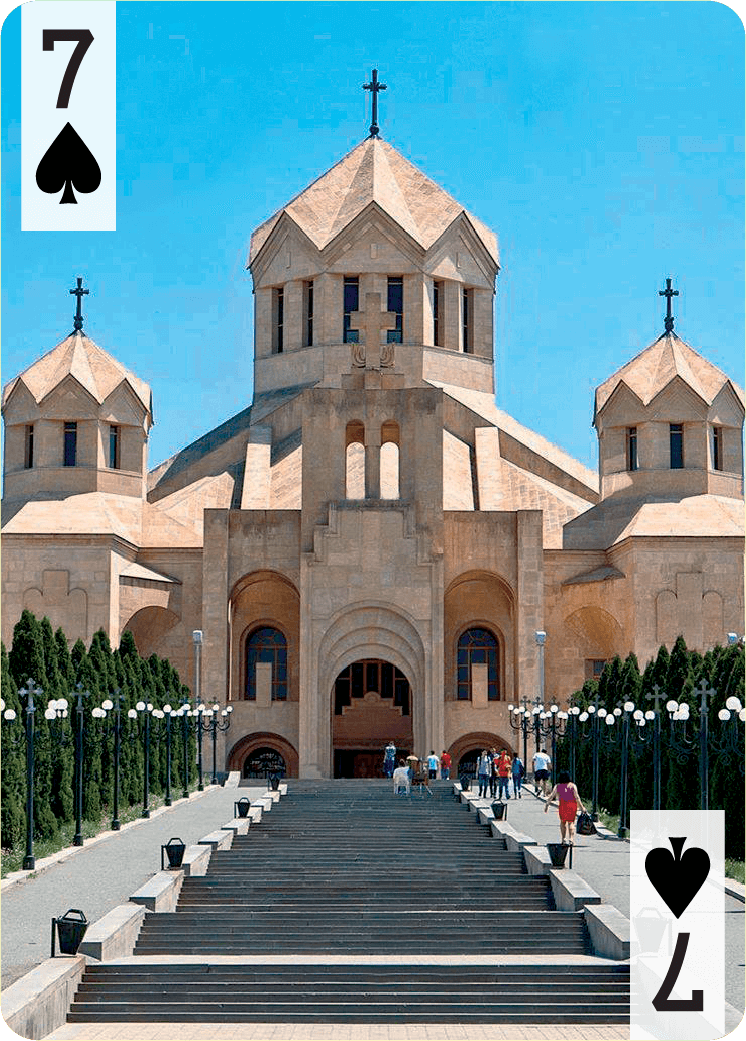
7 Spades – Cathedral of St. Gregory the Illuminator
The cathedral was built to commemorate the 1700th anniversary of Armenia’s adoption of Christianity as the state religion. In its narthex is kept a part of the relics of St. George, transferred to Armenia from Italy (from the Armenian church in Naples), where they had been preserved for the last 500 years.
The relics were handed over to the Catholicos of All Armenians Karekin II by Pope John Paul II. The ceremony took place on November 11, 2000, at the Vatican.
The enormous Cathedral consists of three churches: the main Cathedral church with 1,700 seats, the Chapel of King Saint Trdat III, and the Chapel of Queen Saint Ashkhen (both seating 150), who were the most significant helpers of St. Gregory in Armenia’s adoption of Christianity. A bell tower is located at the entrance to the Cathedral.
The consecration of the cathedral took place on September 23, 2001.
Location – southeastern part of the Circular Park (opposite the “Russia” cinema).
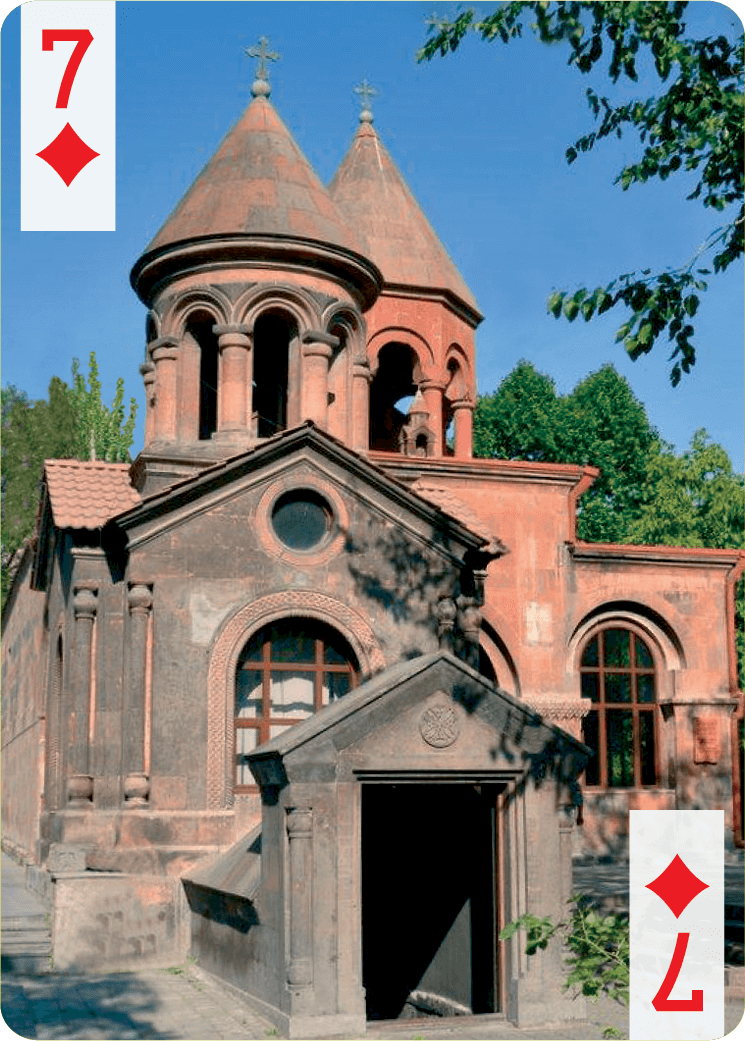
7 Diamonds – Holy Mother of God the Mighty Church
The Surb Zoravor Astvatsatsin Church (Holy Mother of God) was founded in the 9th century, later rebuilt between 1632–1635, destroyed in the 1679 earthquake, and rebuilt again in 1693–1694. It is one of the oldest surviving churches in Yerevan. The territory also includes the chapel-tomb of the holy Apostle Anania, whose name is mentioned in the Bible.
According to a manuscript preserved in the church, the church was named after the Holy Mother of God (Astvatsatsin), and the name Zoravor (“Mighty”) was added later — meaning it was revered as mighty, capable of performing miracles.
Location – 2nd lane of Tumanyan Street, 4.
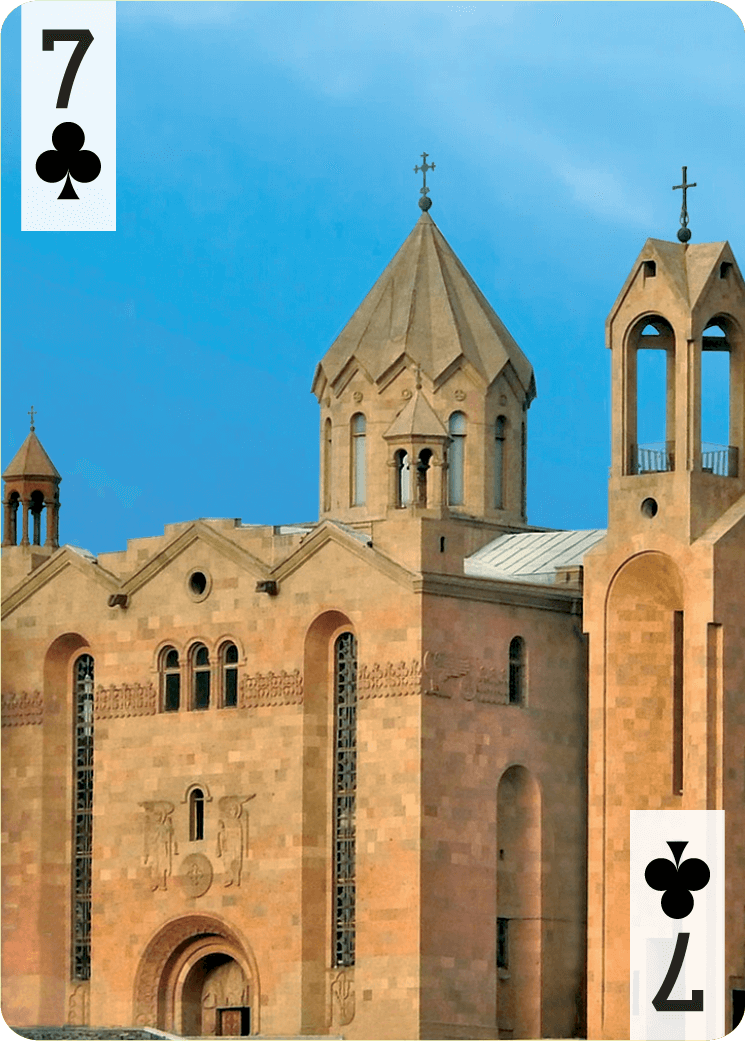
7 Clubs – Church of Surb Sarkis
An Armenian vicarage church founded in 1450. It was then a large complex surrounded by a high fortress wall, including the churches of Saint Sarkis, Saint Gevork, and Saint Hakob, the vicarate buildings and parish school, garden, and other constructions. The Church of Saint Sarkis was the official residence of the Patriarch.
The church was destroyed in the great earthquake of 1679 but restored on the same site during the reign of Catholicos Nahapet Edesatsi (1691–1705). The current church building was constructed between 1835–1842 and consecrated in the name of Saint Sarkis — the patron of lovers.
During the reign of Catholicos Vazgen I, the church underwent major reconstruction. The old building was covered with orange tuff; a gallery for the choir and a bell tower were added on the western side. Only part of the old vault remains, visible when entering the small right oratory and looking upward.
Location – 21 Israelyan Street.
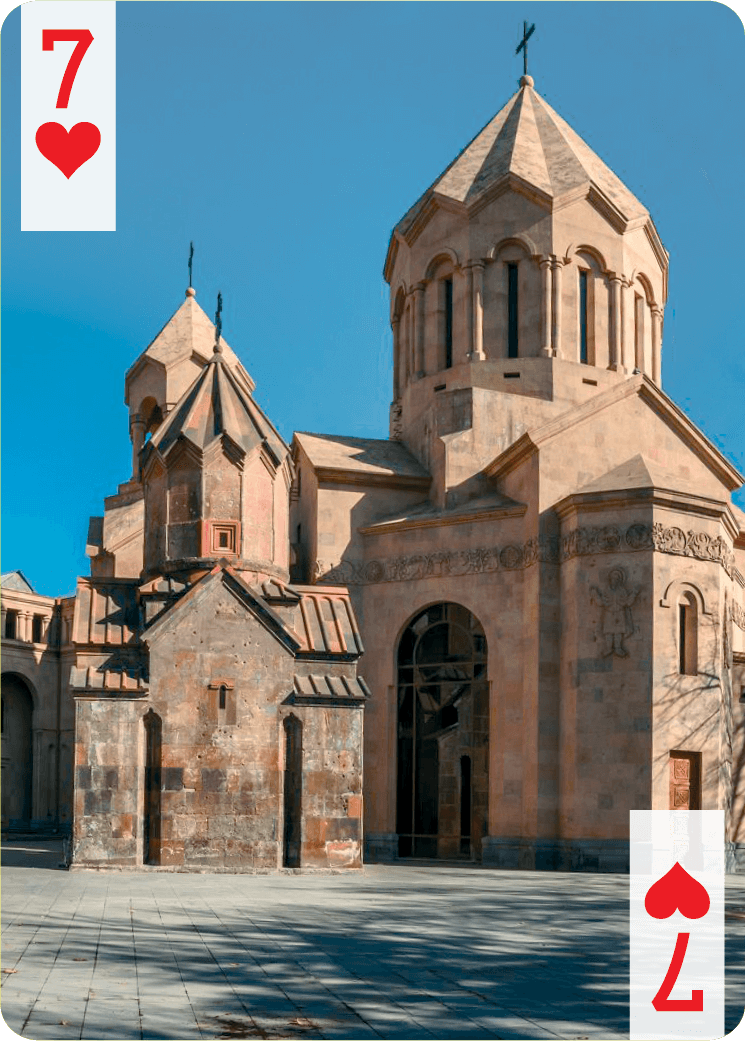
7 Hearts – Church of Saint Anna
An Armenian Apostolic church dedicated to Saint Anne, built in 2015. To the west of it lies the Residence of the Catholicos.
The Church of Saint Anna incorporates the ancient Katoghike Church and is built in a similar architectural style.
The oldest inscriptions carved on one of the walls of Katoghike date back to 1264. After the 1679 earthquake, a large basilica of the Holy Mother of God was added to the western part of the church. In 1936, the basilica was demolished to free space for residential buildings and the Linguistic Institute. During the demolition, hidden within the structure of the great basilica, the ancient church of Katoghike was revealed. After protests by archaeologists, the church was preserved. Numerous old khachkars from the 15th–17th centuries were found in the walls of the ruined church.
The current Holy Mother of God Church, still called Katoghike, is relatively small and due to very limited space, is used only as a chapel-prayer room.
Location – intersection of Abovyan and Tumanyan Streets.