




Symbols of Soviet Architecture
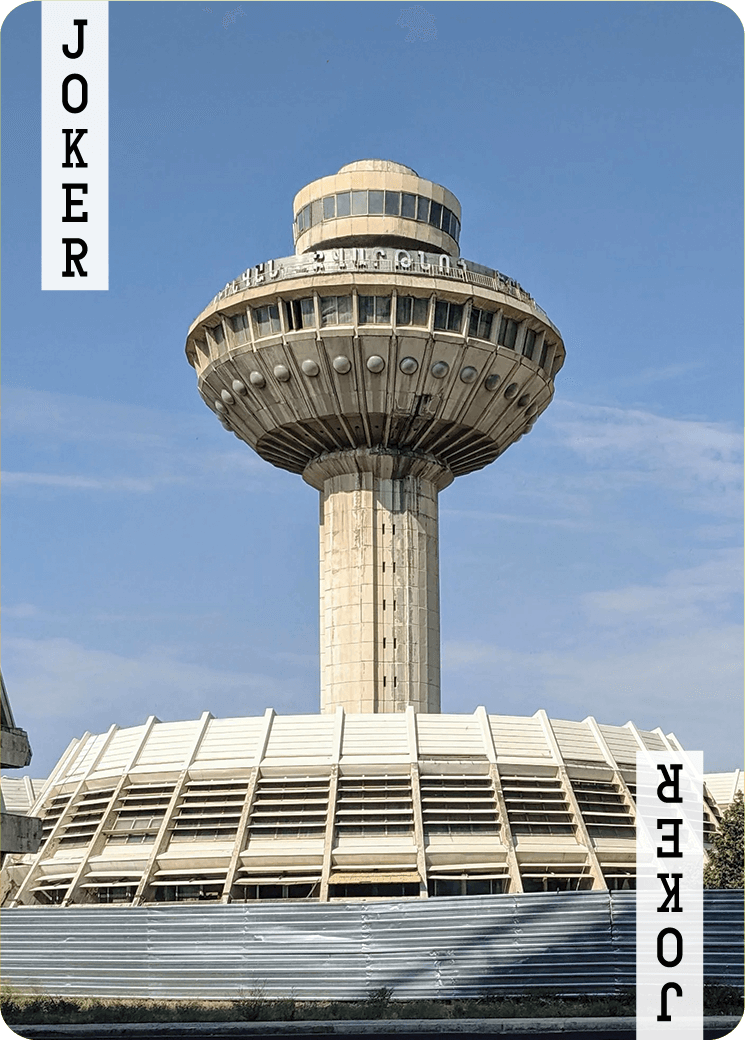
Zvartnots Airport
Zvartnots Airport is a monument of Soviet modernist architecture. Its story began in the early 1970s, when an open architectural competition was announced. The first prize was awarded to engineer S. Baghdasaryan and a group of architects led by A. Tarkhanyan.
Construction proceeded quite quickly, and Zvartnots opened in 1980.
During construction, it was nicknamed both “the unidentified flying object” and “the spaceship.” You could almost make a Star Wars movie about it! However, for obvious reasons, no overseas directors could come to the USSR back then. So, this unusual building of the Soviet Union’s most modernist airport appeared in only one famous film — the Soviet-Polish children’s hit of the 1980s The Adventures of Mr. Kleks. According to Polish filmmakers, “Zvartnots” simply captivated them with its cosmic uniqueness.
The old Zvartnots Airport (like the ancient Zvartnots temple) became a true symbol of Yerevan. But by the early 2000s, reconstruction became necessary, and in 2004 the construction of a new airport began.
Still, the old terminal, although unused for many years, continues to attract attention to this day.
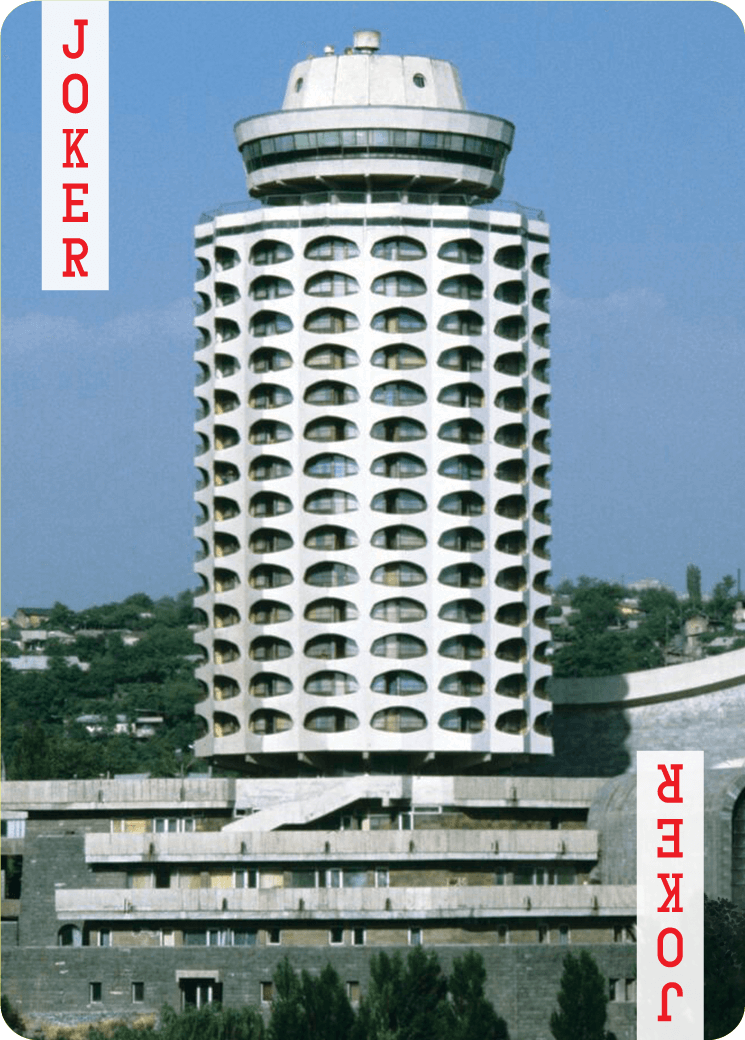
House of Youth
On the occasion of the 50th anniversary of the USSR, Soviet authorities decided to build Palaces of Youth in the capitals of all republics. The Yerevan Palace was planned to be built on a high spot, visible from all sides. The height of Kanaker, at the end of Abovyan Street, was chosen. The Palace of Youth was inaugurated in 1979.
Architects: Hrach Poghosyan, Artur Tarkhanyan, and Spartak Khachikyan.
The complex included a system of terraces, a 14-story hotel with 500 rooms, and a cinema-concert hall with 1,200 seats. On the top floor was a café with a rotating floor. During one hour, the café would make a full turn, allowing visitors to enjoy the city view. Reservations had to be made in advance. The first terrace housed an indoor swimming pool, administrative offices, creative workshops, and photo and cinema hobbyists’ labs. The second terrace included the wedding hall, banquet halls, a disco, restaurant, and café. At the Palace’s grand opening, the first wedding was registered in the wedding hall. Officially, the first newlyweds were workers of the Yerevan Mechanical Plant, Smbat and Alvard Avetisyan. In fact, on that day (April 7, 1979) four couples registered their marriages, and the first were Ara Asoyan (now Armenia’s chief epidemiologist) and his wife.
The third terrace housed the hotel lobby and the tourist service bureau.
In the 1980s, the Palace of Youth played a major role in the Armenian rock movement.
The interior of the palace was filled with youthfulness and spring freshness — the bar featured a gilded sculpture “Adam and Eve” (by Mkrtich Mazmanyan), and the lobby had Tom Gevorkyan’s work called “Spring.” Armine Kalents created a series of frescoes depicting Armenia; Zorik Stepanyan made a wooden map of Armenia displayed on one of the lobby walls. Nelly Asatryan’s tapestry decorated the Reception Hall. Thanks to Martin Zakaryan, the Palace’s wedding hall featured famous stained-glass windows. The fate of these artworks today is unknown.
In 2005, a decision was made to demolish the building… Unfortunately, one of Armenia’s capital’s symbols was destroyed…